Commercial Roofing for Healthcare Systems in Meridian, ID

Healthcare roofing in Meridian, ID needs access controls, room-level leak tracing, and repair phases coordinated with patient and clinical operations.

Healthcare Systems

A damp mark over a treatment room needs a roof check with patient flow in mind. We inspect the roof zone, nearby drains, curbs, and transitions. A useful service request names the street, clinic wing, affected room, and nearest roof access point. Add symptom timing, prior repairs, and the facilities lead. A healthcare network may include clinics, offices, and larger care campuses. We keep the findings tied to the exact building and access plan.

Set Clinical Controls Before Entry

Facilities staff confirm check-in, escort, roof access, interior entry, and delivery routes. We ask which entrances and corridors must remain open. The site contact identifies rooms that need advance notice, equipment areas with restricted access, and hours when noise or staging should be limited. Roofing crews do not define clinical restrictions. The facility authority sets those controls and approves the work boundary.

A multi-building system may use different contacts for clinics, administrative offices, and service areas. We record the person who can approve room protection and the contact who receives shift updates. If another contractor must service rooftop equipment, we coordinate the curb access before repairing the flashing. Work can be divided by roof section, with each opening secured at the end of the shift.

The Boise VA Medical Center is a regional hospital and clinic campus in Boise, and its care network serves Idaho and eastern Oregon. Ten Mile Crossing includes medical services among its commercial uses. These are distinct settings near Meridian. We do not transfer one site's patient controls or roof design to another. The facility representative supplies the applicable access and operating requirements.

Trace Each Report to a Roof Detail

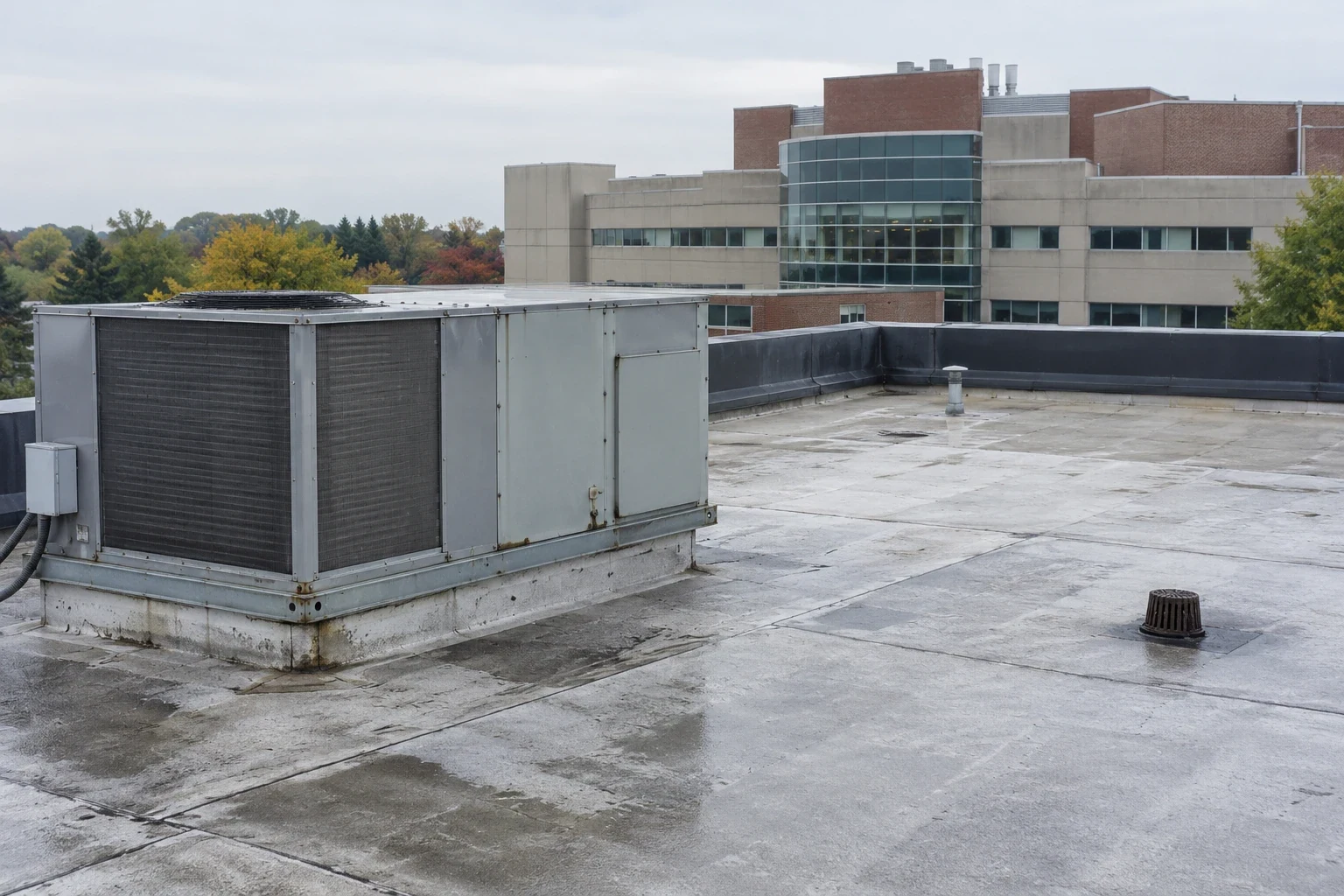
We place the reported room on a plan, then inspect the roof directly above and along likely drainage paths. The review covers membrane seams, penetration flashings, drains, overflow routes, rooftop equipment bases, and edge transitions. Photos connect each finding to a roof zone. A ceiling mark alone does not prove the opening. We separate visible damage from a suspected water route until evidence confirms it.

Clinics and campuses may have additions, different roof assemblies, and equipment installed at different times. We note system changes and any service records the facilities team provides. A mechanical replacement can disturb a curb or flashing. A prior ceiling repair can hide the original symptom. Each observation is tied to the building and date so later reports can be compared without blending separate histories.

Eagle View Landing includes office, retail, medical, and corporate-campus space near Eagle Road and I-84. El Dorado Business Campus is an office park near Interstate 84 and close to St. Luke's Meridian Medical Center. These local settings illustrate the region's office and medical presence. They do not tell us how a specific clinic roof drains. We check the actual roof plan, outlets, and access points. If a legacy plan uses older room labels, facilities can add current names before inspection. The photo log keeps both references for later review.

Healthcare Systems in Meridian, ID

Confirm Moisture Before Opening the Assembly

Water may travel along a deck or insulation before appearing in a treatment, records, or staff room. We inspect uphill from the report and check nearby curbs, drains, wall returns, and seams. Facilities staff can share when the leak began and whether equipment service or a recent storm coincided with the first mark. That history guides the inspection without replacing roof evidence.

Boise Air Terminal is a nearby weather reference for Meridian. July averages a 92.7°F daily high, and December averages a 25.4°F daily low, according to nearby Boise Air Terminal climate normals. We use those normals to frame seasonal questions, then inspect the facility roof for actual membrane movement, open sealant, drainage restrictions, and ponding. We describe membrane movement, sealant condition, drainage restrictions, and ponding observed at the building.

Infrared review may help locate a moisture pattern when conditions support the method. A test cut can confirm insulation and deck layers at one selected point. We identify the question, mark the sample, coordinate protection below, and restore the opening. Results apply to the tested area. A broader removal needs additional evidence and approval. The report says what is confirmed and what remains uncertain.

Healthcare Systems in Meridian, ID

Phase the Scope by Clinical Impact

A puncture, open seam, or failed curb may accept a local repair if adjacent material remains sound. We identify the roof system, prepare the area, and state the repair limit. Wet insulation or damaged deck can require selective removal. The work order notes any room protection, shutdown, or equipment access needed. Facilities staff review that sequence before the roof is opened.

Wider deterioration calls for a comparison of repair, recover, coating, and replacement. Moisture, attachment, drainage, deck condition, and system compatibility guide the choice. Coating requires a dry, compatible surface. A recover only makes sense when the existing assembly can support another layer. Projects can be phased by building or zone, but every active opening needs weather protection and a confirmed closure plan.

Healthcare work may include occupied-building phasing, moisture review, or drain correction. We can inspect a medical office roof or a hospital roof after confirming the actual use and access. A property manager may coordinate several addresses, while a school district has separate occupancy controls.

Healthcare Systems in Meridian, ID

Preserve a Building-Level Maintenance Record

Closeout photos identify the roof area, repair material, test result, and approved boundary. We list rooms not accessed and any question left open. Facilities can attach the record to a work order and compare a later symptom with the same roof location. The report distinguishes a completed repair from a recommended follow-up.

Maintenance review can revisit drains, penetrations, equipment curbs, and previous repairs before symptoms recur. A planned roof check can be scheduled by building. A condition report can organize findings for capital review. Each recommendation follows the facility's own inspection and access record.

For local routing, El Dorado Business Campus and Eagle View Landing are separate reference points. Dispatch still needs the actual address, active leak location, roof history, and facility contact. Include escort details, room-entry limits, and any equipment window. That lets the first visit start with a clear route.

What information helps plan a healthcare roof visit?

Provide the building address, room or service area, leak location, roof history, and facilities contact. Add escort, patient-route, room-entry, and equipment restrictions. The facility representative approves the work boundary.

Can roofing work be phased while a clinic remains open?

Facilities staff decide which rooms and routes must remain available. We can sequence work by roof zone when conditions allow, with temporary protection and an end-of-shift close for each opening.

When is infrared testing useful?

It can help identify a moisture pattern when conditions support the survey. If a sample opening is needed, we identify its purpose and location, coordinate protection below, and report what the sample confirms.

Does a campus report cover every building?

No. Each roof assembly, access route, and finding stays tied to its building. A separate inspection may be needed before applying a recommendation to another structure.

Set a Facility-Specific Inspection

Send dispatch the Meridian address, active leak location, roof history, building and room, and facilities contact. Include escort, patient-access, and equipment constraints so the first visit follows the approved route.

Call 555-555-5555 or fill out the form and we will be in touch.

Got a Leak?

For active leaks, storm damage or other urgent roof problems, call us directly at: 555-555-5555.

ServicesRoof SystemsProperty TypesIndustriesService AreasDamage RepairCapabilitiesManufacturersAboutRequest a Roof Assessment555-555-5555
Call555-555-5555